

系统架构
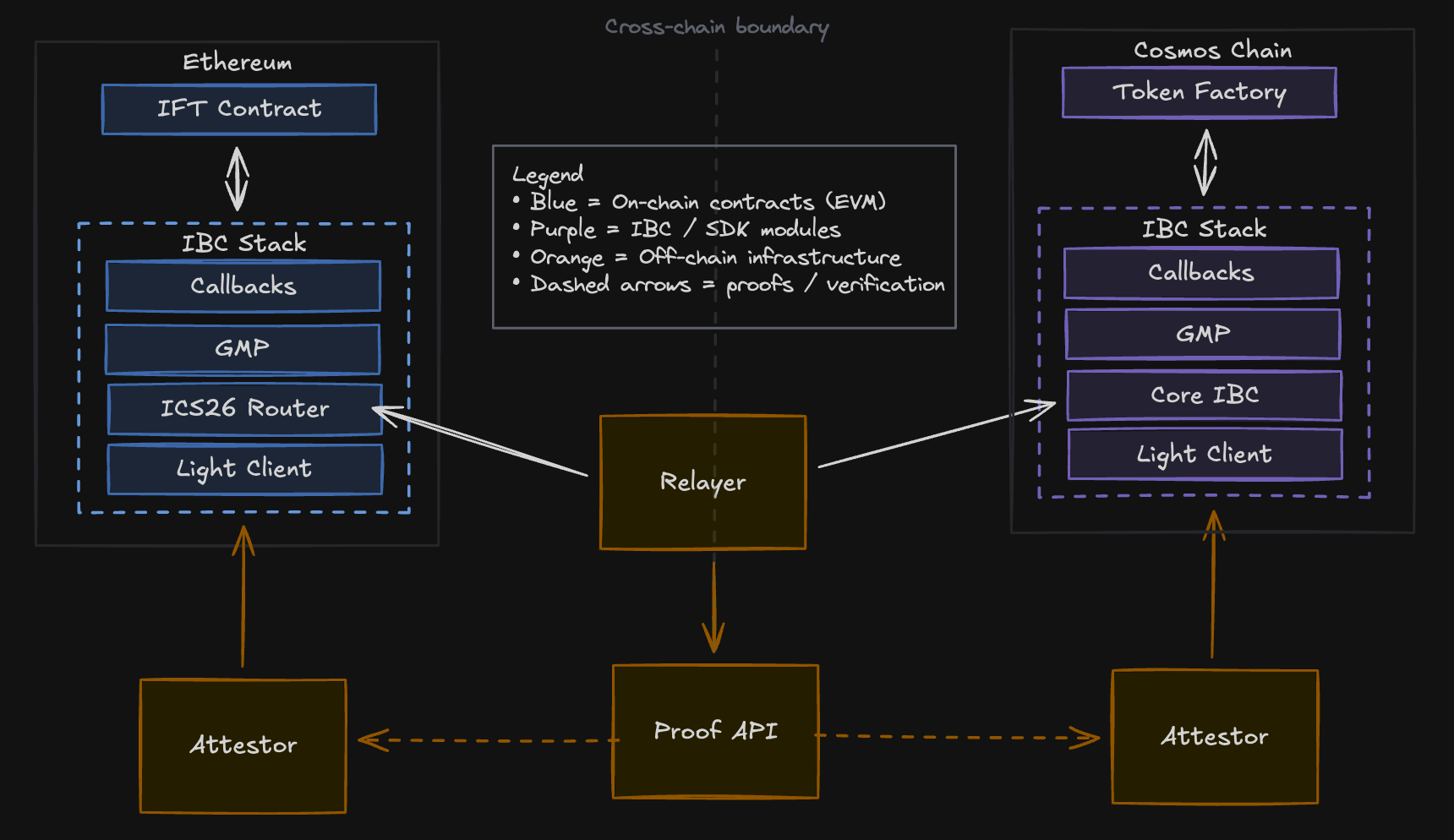 图例
图例
- 蓝色 = 链上合约(EVM)
- 紫色 = IBC / SDK 模块
- 橙色 = 链下基础设施
- 虚线箭头 = 证明 / 验证
组件
链上
Cosmos 模块-
核心 IBC 模块 —— 核心 IBC 栈,包括 ICS 26 Router、ICS 26 Application Callbacks 和 ICS 27 GMP。
- 规范: cosmos/ibc
- 实现: cosmos/ibc-go
- Attestor 轻客户端 —— 一种基于 attestor 的 IBC 轻客户端,使用来自固定可信签名者集合、达到法定阈值的 ECDSA 签名证明来验证 IBC 数据包,采用 Go 实现。
- Token Factory —— 与具体链相关的模块,负责核心资产逻辑,并与 IBC 栈集成,用于发起出站 IBC 数据包和/或处理入站 IBC 数据包。
-
核心 IBC 合约 —— 核心 IBC 合约,包括 ICS 26 Router 以及 ICS 27 GMP + Callbacks 合约。
- 规范: cosmos/ibc
- 实现: cosmos/solidity-ibc-eureka
- Attestor 轻客户端 —— 一种基于 attestor 的 IBC 轻客户端,使用来自固定可信签名者集合、达到法定阈值的 ECDSA 签名证明来验证 IBC 数据包,采用 Solidity 实现。
- 跨链同质化代币(IFT) —— 一组规则和接口,用于创建和管理可通过 ICS-27 GMP 在不同区块链网络之间转移的同质化代币。
链下
-
证明服务 —— 轻量级、与区块链无关的证明服务,为 IBC 跨链通信提供带有密码学签名的区块链状态证明。详情请参阅 Attestor 文档。
- 实现: cosmos/ibc-attestor(位于
apps/ibc-attestor/的 Rust 服务)
- 实现: cosmos/ibc-attestor(位于
- Proof API —— 一个 gRPC 服务器,客户端可查询它以获取生成中继 IBC 数据包所需交易的数据。
- 中继器 —— 一个独立的、可用于生产环境的、请求驱动的 IBC v2 协议中继服务。详情请参阅 Relayer 文档。
IBC 转账流程示例
Cosmos 到 EVM
-
用户或客户端在 Cosmos 源链上提交一笔交易,其中包含发送到 Token Factory 模块的 burn/transfer 消息。
- Token Factory 模块调用 IBC GMP 模块,向 EVM 目标链上的 IFT 合约的 mint 函数发起一次 GMP 调用。
- GMP 模块调用核心 IBC 模块,发送一个携带 GMP 负载的数据包到 EVM 目标链上的 ICS 26 Router。
- IBC 模块将相关数据包信息作为事件发出。
- Attestor 持续监控区块中的相关 IBC 事件,解析出有效的 IBC 转账数据包,并生成带签名且附带相关区块链状态的证明。
-
客户端向中继服务提交请求,以中继该 IBC 转账数据包。
- 中继器向 Proof API 请求在目标链上提交 IBC 交易及证明所需的数据。
- Proof API 查询每个已配置的 Attestor,聚合签名证明直到达到法定阈值,生成 IBC RecvPacket 数据,并返回给中继器。
-
中继器将 IBC RecvPacket 交易提交到 EVM 目标链。
- ICS 26 Router 合约解析数据包并执行核心校验逻辑(顺序、超时等),然后将其路由到相应的轻客户端合约。
- 轻客户端合约验证 IBC 数据包。
- ICS 26 Router 将已验证的数据包路由到 GMP 合约,由其执行 IFT 合约的 mint 函数。
- IFT 合约铸造代币,并将其转账到 GMP 负载中指定的目标地址。
EVM 到 Cosmos
-
用户或客户端在 EVM 源链上提交一笔交易,调用 IFT 合约上的
iftTransfer。- IFT 合约销毁发送方的代币,并使用 IBC mint/burn 转账数据包所需的信息调用 ICS 27 GMP 合约。
- GMP 合约调用 IBC Router 合约,发起一次 GMP 调用以在 Cosmos 目标链上铸造代币。
- IBC 合约将相关数据包信息作为事件发出。
- Attestor 为该数据包及相关区块链状态生成带签名的证明。
-
客户端向中继服务提交请求,以中继该 IBC 转账数据包。
- 中继器从 Proof API 请求数据,后者聚合证明并生成 IBC RecvPacket 数据。
-
中继器将 IBC RecvPacket 交易提交到 Cosmos 目标链。
- 核心 IBC 模块解析数据包并执行核心校验逻辑(顺序、超时等),然后将其路由到相应的轻客户端模块。
- 轻客户端模块验证 IBC 数据包。
- IBC 核心模块将已验证的数据包路由到 GMP 应用模块。
- GMP 模块调用 Token Factory 模块,将代币铸造到 GMP 负载中指定的目标地址。
This document explains how an IBC v2 deployment works end-to-end to support mint/burn transfers between Cosmos and EVM chains using the IBC v2 protocol, the enterprise-ready relayer, and the attestor service.
System Architecture
Legend
- Blue = on-chain contracts (EVM)
- Purple = IBC / SDK modules
- Orange = off-chain infrastructure
- Dashed arrows = proofs / verification
Components
On-Chain
Cosmos Modules-
Core IBC Modules — Core IBC stack including the ICS 26 Router, ICS 26 Application Callbacks, and ICS 27 GMP.
- Specifications: cosmos/ibc
- Implementations: cosmos/ibc-go
-
Attestor Light Client — An attestor-based IBC light client that verifies IBC packets using quorum-signed ECDSA attestations from a fixed set of trusted signers, implemented in Go.
- Specification: cosmos/ibc ics-026-application-callbacks
- Implementation: cosmos/ibc-go attestor light client
- Token Factory — Chain-dependent module that handles core asset logic and is configured with the IBC stack to initiate outgoing and/or process incoming IBC packets.
-
Core IBC Contracts — Core IBC contracts including the ICS 26 Router and ICS 27 GMP + Callbacks contracts.
- Specifications: cosmos/ibc
- Implementations: cosmos/solidity-ibc-eureka
-
Attestor Light Client — An attestor-based IBC light client that verifies IBC packets using quorum-signed ECDSA attestations from a fixed set of trusted signers, implemented in Solidity.
- Specification: cosmos/solidity-ibc-eureka design
- Implementation: cosmos/solidity-ibc-eureka attestation
-
Interchain Fungible Token (IFT) — A set of rules and interfaces for creating and managing fungible tokens that can be transferred across different blockchain networks using ICS-27 GMP.
- Implementation: cosmos/solidity-ibc-eureka IFTBase.sol
Off-Chain
-
Attestation Service — A lightweight, blockchain-agnostic attestation service that provides cryptographically signed attestations of blockchain state for IBC cross-chain communication. See the Attestor documentation for details.
- Implementation: cosmos/ibc-attestor (Rust service in
apps/ibc-attestor/)
- Implementation: cosmos/ibc-attestor (Rust service in
-
Proof API — A gRPC server that can be queried by a client to get the data needed to generate transaction(s) for relaying IBC packets.
- Implementation: cosmos/solidity-ibc-eureka proof-api
- Relayer — A standalone, production-ready, request-driven relayer service for the IBC v2 Protocol. See the Relayer documentation for details.
Example IBC Transfer Flows
Cosmos to EVM
-
The user or client submits a transaction on the Cosmos source chain containing a burn/transfer message to the Token Factory module.
- The Token Factory module calls the IBC GMP module to make a GMP call to the mint function on the EVM destination chain’s IFT contract.
- The GMP module calls the core IBC module to send a packet with the GMP payload to the ICS 26 Router on the EVM destination chain.
- The IBC modules emit the relevant packet information as an event.
- The Attestor continuously monitors blocks for relevant IBC events, parses a valid IBC transfer packet, and generates a signed attestation with associated blockchain state.
-
The client submits a request to the relayer service to relay the IBC transfer packet.
- The relayer requests data necessary to submit the IBC transaction and proof on the destination chain from the Proof API.
- The Proof API queries each configured Attestor, aggregates signed attestations until the quorum threshold is reached, generates the IBC RecvPacket data, and responds to the relayer.
-
The relayer submits the IBC RecvPacket transaction to the EVM destination chain.
- The ICS 26 Router contract parses the packet and executes core validation logic (sequencing, timeouts, etc.), then routes it to the relevant light client contract.
- The light client contract validates the IBC packet.
- The ICS 26 Router routes the validated packet to the GMP contract, which executes the IFT contract’s mint function.
- The IFT contract mints and transfers the token to the destination address specified in the GMP payload.
EVM to Cosmos
-
The user or client submits a transaction on the EVM source chain calling
iftTransferon the IFT contract.- The IFT contract burns the tokens from the sender and calls the ICS 27 GMP contract with the necessary information for an IBC mint/burn transfer packet.
- The GMP contract calls the IBC Router contract to send a GMP call to mint tokens on the Cosmos destination chain.
- The IBC contracts emit the relevant packet information as an event.
- The Attestor generates a signed attestation of the packet and associated blockchain state.
-
The client submits a request to the relayer service to relay the IBC transfer packet.
- The relayer requests data from the Proof API, which aggregates attestations and generates IBC RecvPacket data.
-
The relayer submits the IBC RecvPacket transaction to the Cosmos destination chain.
- The core IBC modules parse the packet and execute core validation logic (sequencing, timeouts, etc.), then route it to the relevant light client module.
- The light client module validates the IBC packet.
- The IBC Core modules route the validated packet to the GMP application module.
- The GMP module calls the Token Factory module to mint tokens to the destination address specified in the GMP payload.